
Beyond Intent: The Real Drivers of Household Waste Sorting Errors
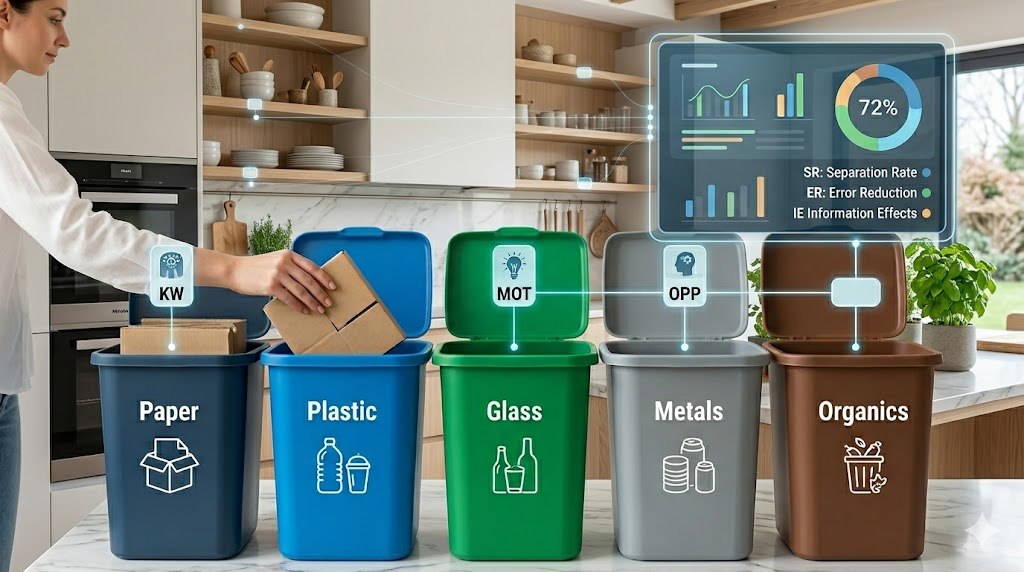
The Global Challenge of Waste Management
According to recent studies, municipal waste generation exceeds 2 billion tons annually and is projected to rise by 56% by 2050. Even in countries with advanced infrastructure like Germany, household sorting errors remain a persistent challenge, undermining recycling efficiency and circular economy goals. Understanding why these errors happen is the first step toward a more sustainable future.
The MOA Framework: Motivation, Opportunity, and Ability
To analyze waste separation behavior, researchers apply the Motivation-Opportunity-Ability (MOA) framework.
- Motivation: This includes personal values, environmental awareness, and the perceived importance of recycling.
- Opportunity: Refers to external factors such as the accessibility of collection points and the clarity of local disposal rules.
- Ability: Encompasses the knowledge and skills required to identify materials correctly and integrate sorting into daily routines.
The Hidden Barriers: Infrastructure and Knowledge
Interestingly, research shows that while many people have high environmental motivation, they still make significant sorting errors. The primary predictors of these errors are structural and cognitive barriers.
- Structural Barriers: Inconveniently located bins or limited space in multi-family households often lead to incorrect disposal.
- Knowledge Gaps: Uncertainty about material categories and confusing packaging labels are major hurdles for even the most well-intentioned residents.
The Power of Targeted Information Flyers
Field experiments demonstrate that simple, well-designed information interventions can drastically improve sorting accuracy. In a study involving 102 households, the distribution of an environmental flyer led to a 69.7% reduction in sorting errors in the intervention group, compared to only 28.8% in the control group.
Why Flyers Work: Motivational Salience
Unlike complex manuals, simple flyers provide "motivational salience" by highlighting the ecological benefits of waste separation.
- Cost-Effectiveness: Flyers are a scalable and low-cost strategy for municipalities to engage citizens.
- Closing the Intent-Action Gap: By serving as a visual reminder, they help translate environmental intentions into correct daily behaviors.
Socioeconomic Impacts on Sorting Accuracy
Waste sorting behavior is also shaped by the socioeconomic characteristics of a neighborhood.
- Stronger Areas: Often benefit from better infrastructure and more exposure to environmental education.
- Disadvantaged Areas: Face challenges like overcrowded housing and poorly located collection points, which can diminish individual efforts.
Conclusion:
A Holistic Approach to Circular Economy*To achieve a true circular economy, information is not enough. Municipalities must address infrastructural constraints (Opportunity) alongside informational tools (Ability). By combining accessible recycling systems with targeted communication, we can significantly reduce contamination in recycling streams and preserve vital resources for future generations.